

Beyond the Office
How AI is changing what one person—and one family—can build.

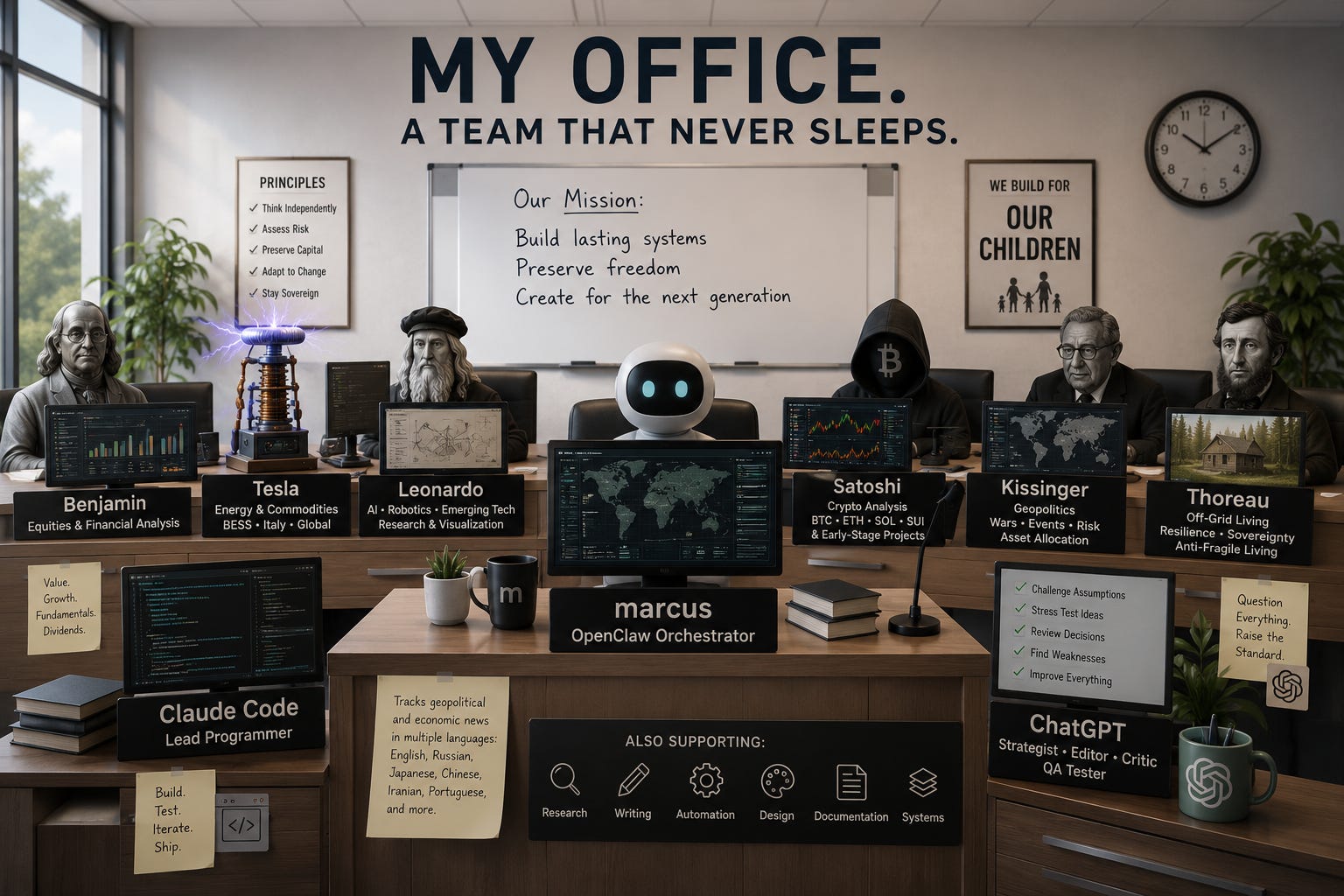
I have somehow built my own version of The Office.
Except I have no employees, no physical office, and the team never sleeps.
There are now more than 12 of us.
At the centre is marcus, my OpenClaw orchestrator. It is the one that keeps everything moving, coordinating the other agents, tracking developments and making sure the right specialist is working on the right problem.
marcus never really switches off. It monitors geopolitical and economic news across English, Russian, Japanese, Chinese, Iranian, Portuguese and other sources. That matters because reading only the English-language interpretation of the world is no longer enough. The same event can be framed very differently depending on where you are reading it, and those differences can shape politics, markets and investment decisions.
marcus coordinates six main analysts, each named for a reason.
Benjamin, named after Benjamin Graham, handles equities and financial analysis. It reflects my own bias: I like growth, but I also believe in value, fundamentals and dividend-paying businesses.
Tesla, named after Nikola Tesla, focuses on energy, commodities and BESS, particularly in Italy, but also across the wider global energy transition.
Leonardo, named after Leonardo da Vinci, looks at AI, robotics, emerging technologies, research and visualisation — essentially, what comes next.
Satoshi, named after Satoshi Nakamoto, covers crypto, mainly Bitcoin, Ethereum, Solana and Sui, while also tracking earlier-stage projects that may offer asymmetric upside.
Kissinger, named after the former US Secretary of State, focuses on geopolitics: wars, shifting alliances and major events that could affect our lives, our investment thesis and our asset allocation.
Thoreau, named after Henry David Thoreau, tracks off-grid living, resilience, energy independence and the practical side of building a more sovereign and antifragile existence.
These are not abstract research exercises. They increasingly feed into real systems.
One example is the home solar PV, Bitcoin and Kaspa mining system we have been building together. The idea is relatively simple: use surplus solar generation that might otherwise be wasted, convert some of it into productive computing power, and connect energy independence with digital asset accumulation.
It brings together Tesla’s energy work, Satoshi’s crypto analysis and Thoreau’s focus on resilience in one practical system.
Then there is Claude Code, which acts as my principal programmer, supported by several other coding agents, as I build AEGISfo, our family office operating system.
ChatGPT plays a different role: strategist, editor, critic and increasingly relentless QA tester.
Other agents support research, writing, automation, design and documentation.
The obvious benefit is productivity, but that is not really the point.
The point is leverage.
A few years ago, capabilities like this required a company, a research department, an investment committee, a software team and a serious budget. Now one person can begin to assemble something that looks remarkably similar — and keep it operating around the clock.
That changes what an individual can build.
It also raises a more important question: what are we building, and who are we building it for?
I have three children, and much of this is ultimately for them. Not simply the assets, companies or systems, but the thinking behind them: how to assess risk, preserve capital, think independently, adapt to change and remain grounded in a world that is becoming more complex.
I do not think a family legacy should be a static pile of assets.
It should be a living system — something that preserves knowledge, principles and experience, while still leaving the next generation free to make its own decisions and build something different.
That is how I increasingly think about this AI organisation.
Not merely as a collection of tools helping me work faster, but as a form of institutional memory: research, judgment, processes and accumulated knowledge that may continue to serve my family over time.
This is not about replacing people. Human judgment, responsibility, courage and love remain irreplaceable.
It is about extending what one person can do, while keeping that capability anchored to a human purpose.
So yes, I have built my own version of The Office.
It just happens to be a multidisciplinary team of more than 12 agents, coordinated by marcus, operating around the clock.
And I am not building it only for what I can achieve in my own lifetime.
I am building it so my children start with better tools, better maps and a wider horizon than I did.
I agree that AI is great for extending what human beings can do, not replace them. I am finding it to be an excellent research assistant.